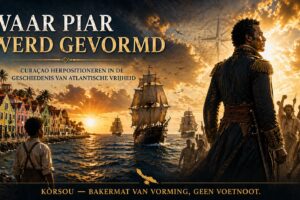


The Curaçao Origins of Manuel Carlos Piar and a Revolution Already in Motion
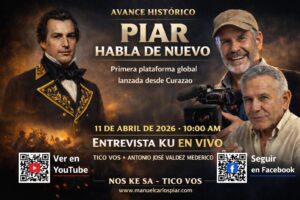
By Tico Vos — Nos Ke Sa
There are historical figures whose stories are told from the moment they become visible. And there are those whose stories must be retold—because they have been starting in the wrong place.
Manuel Carlos Piar belongs to the latter.
In most historical accounts, Piar appears in Venezuela—on battlefields and in the campaigns later associated with Simón Bolívar. There, he is introduced as a general, a strategist, a controversial figure. But by the time he enters that stage, something essential has already happened:
He has already been formed.
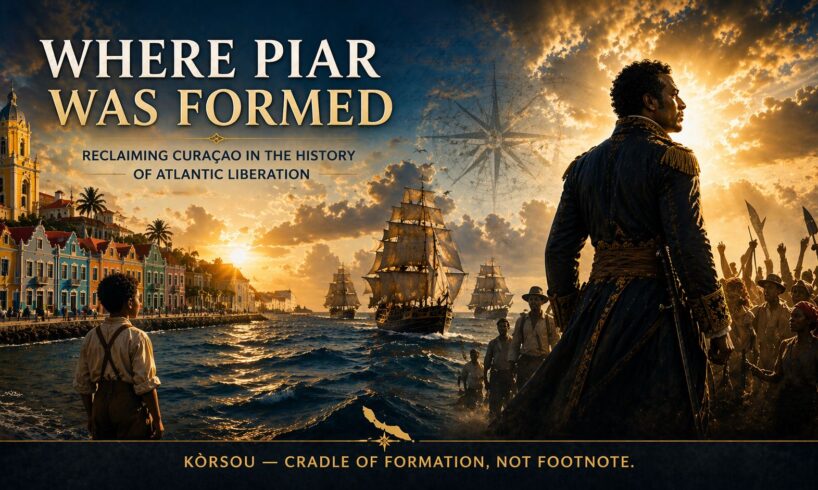
To understand Piar, we must begin where history has too often paused only briefly—Curaçao.
An Island That Spoke Many Worlds
In the late eighteenth century, Curaçao was not a quiet colonial outpost. It was a dense Atlantic crossroads—a place where enslaved Africans, free Black communities, European merchants, sailors, and colonial administrators occupied the same space, though never under the same conditions.
In Willemstad—and more specifically in Otrobanda, Rifwaterstraat—a young Piar grew up in a world defined by interaction, tension, and exchange.
He did not grow up in one language.
He grew up in many:
•Papiamentu
•Spanish
•Dutch
•English
•French
•and African languages carried by enslaved communities
These were not just languages.
They were worlds.
To move between them required more than speech. It required awareness, adaptability, and the ability to understand people across boundaries.
This environment was not incidental.
It was formative.
A House Between Worlds
At home, those complexities became human.
His mother, María Isabel Gómez, worked as a midwife—one of the few roles in colonial society that crossed all boundaries. She entered homes of the rich and the poor, the free and the enslaved. She witnessed life at its most equal moment—birth—before society imposed its divisions.
No archival record identifies her as a political conspirator. Yet her position reveals something deeper.
In a society where languages overlapped and realities coexisted, she listened across differences. She understood people not through one voice, but through many.
Not a “spy” in the formal sense, but a carrier of awareness—moving through layers of society where information, tensions, and ideas quietly circulated.
At the same time, Curaçao formed part of a wider Caribbean reality in which enslaved individuals sought escape—often across the sea toward the Venezuelan coast. These movements depended on informal networks involving sailors, ship captains, and intermediaries who, quietly and at great risk, facilitated passage out of bondage.
Within such a world, empathy was not abstract—it was lived.
For a young Piar, this meant understanding that freedom was not only an idea.
It was a desire in motion—
crossing waters,
defying systems,
seeking passage wherever it could be found.
The Sea as Education
From his father, a merchant mariner, came another formation—one rooted in movement. The ships that entered Curaçao’s harbor carried more than goods. They carried languages, news, rumors, and strategies from across the Atlantic. For Piar, the sea was not a boundary. It was a network. Long before he commanded vessels, he understood how movement connected worlds.
The Memory of Resistance
Piar’s youth unfolded in the aftermath of the 1795 uprising led by Tula.
This was not distant history.
It was lived memory—spoken differently across communities, but felt everywhere.
It showed that power could be challenged.
And that such challenges carried consequences.
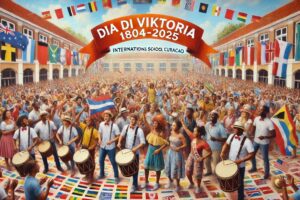
26 February 1804 — A Day of Victory
In 1804, those lessons were tested.
British forces under John Bligh landed at Piscadera Bay and bombarded Willemstad.
The response came not from a formal army—
but from the people.
With machetes.
With tools.
With stones.
And among them stood Luis Brión and Manuel Carlos Piar—not as distant commanders, but as participants within a collective resistance.
What emerged was more than defense.
It was mobilization.
A population—diverse in language, status, and origin—acting together.
On February 26, 1804, the British withdrew.
That moment deserves to be recognized for what it was:
A Day of Victory—won by the people of Curaçao.
The island was described as “the indomitable island.”
For Manuel Carlos Piar, this was more than a military outcome.
It was a formative lesson in the nature of leadership.
Victory did not arise from a formally trained army, nor from rigid military structures.
It emerged from determination—
from the ability to mobilize,
to motivate,
and to involve people from all walks of life in a shared struggle.
Winning did not begin with becoming a soldier.
It began with understanding people— and inspiring them to act.
Identity Beyond Colonial Categories
Piar himself stood at the intersection of colonial classifications.
Contemporary descriptions suggest that he could be perceived, within colonial hierarchies, as more closely aligned with European physical features. In such a system, this often implied proximity to privilege.
Yet his life reflects a different path.
Raised by María Isabel Gómez within the lived realities of Curaçao’s mixed and unequal society, he did not internalize superiority.
He developed an understanding.
He could have belonged to the hierarchy—
but chose to understand the people it excluded.
The Question of Pardocracia: Misreading a Curaçao Formation
One of the most persistent accusations against Manuel Carlos Piar is that of pardocracia—the claim that he sought to elevate people of mixed race above others.
This accusation has been repeated.
But rarely examined from the perspective that matters most:
the society that formed him.
Curaçao, from its earliest Indigenous presence through its colonial development, became a deeply mixed, multilingual, and interconnected society. It was never defined by a single identity, but by constant interaction across differences.
In places like Rifwaterstraat, this was daily life.
People did not exist in isolation.
They worked together, spoke across languages, and navigated shared realities—even within unequal systems.
To interpret Piar through pardocracia as racial domination is to apply a framework shaped by colonial fear.
What if his leadership reflected something else?
Not division— but recognition of a society already beyond rigid hierarchy.
From this perspective, the accusation reveals less about Piar—
and more about those who could not understand him.
A Revolutionary Already in Motion
By the time Piar enters Venezuela, he is not beginning.
He is continuing.
Sources place him within the environment of the Gual and España Conspiracy, confirm his role in Curaçao’s defense, and note his command in Haiti.
Long before commanding warships, he had already seen what ships carried: hope, escape, resistance.
The recognition of Curaçao.
What is at stake is not only the interpretation of Piar.
It is the recognition of Curaçao.
An island where languages met.
Where worlds collided.
Where freedom was already in motion.
Final Reflection
Kòrsou—cradle of formation, not footnote.
Manuel Carlos Piar belongs to the Atlantic world.
But he was formed here.
And that is where the story must begin.
A Final Note for Future Research
This perspective is not an endpoint.
It is an invitation.
An invitation to explore, in greater depth, the role of Curaçao in shaping not only Piar, but a wider network of Caribbean actors in the struggle for freedom.
The question is no longer whether this angle exists.
The question is whether we are ready to study it— fully, seriously, and without limitation.
Tico Vos is a professional photographer, producer, and tourism specialist. He has been documenting the History, Culture, and News of Curaçao. This site is a documentation of the history of Manuel Carlos Piar.